Saturday, June 6, 2009

DataCore Announces Advanced Site Recovery (ASR) for Microsoft Hyper-V and VMware vSphere

At Microsoft TechEd North America, DataCore announced and demonstrated at the Partner Expo a pre-release version of our ASR technology. ASR allows customers to have site level Distributed Disaster Recovery (D-DR). In simple terms, with ASR you can take a primary datacenter (site 1) and divide it into a single or multiple pieces (multiple sites) and perform 1 to many D-DR. ASR is bi-directional out of the box meaning that users can move to their DR site or sites and return or remerge back to the primary, what we call Reverse Disaster Recovery (R-DR). Leveraging DataCore's ASR product users can execute D-DR and R-DR with 2 (yes, I really mean two) clicks.  Did I mention that ASR supports both physical and virtual servers?


Tuesday, April 28, 2009

DataCore Demos Integrated Storage Solutions for Microsoft Infrastructure

At MMS 2009 DataCore Software is demonstrating their new Windows Server 2008 R2 (Server 7) based iSCSI & Fiber Channel storage solution SANsymphony 7.0.  One platform (Server 7), many datacenters and the cloud.  It is nothing short of incredible to see  provisioning and management of storage, systems and applications on a unified platform. 

The live demos show how simple it can be to deploy fabric based storage in real-time with virtualization hosts and virtual machines.  Now as if making deployment easy wasn’t enough, next see the impact of losing 50% of the storage infrastructure that supports the datacenter. 

Did I say “see” the impact, well seeing is believing and when you see half of the storage in the datacenter drop and nothing happens you begin to understand how powerful DataCore’s solution is with Microsoft Infrastructure. 

For those of you familiar with System Center Operations Manager (SCOM) you will appreciate the unprecedented ability to visualize the storage infrastructure as a distributed application, manage  and monitor in one place.

Demos take place at the DataCore booth 617 every hour on the hour during Expo hours throughout MMS.

Microsoft Management Summit 2009

I’m here at the 10th Annual MMS at the Venetian Hotel in Las Vegas.  Microsoft has done a nice job packaging and delivering information on their latest server and management technologies to the user community. 

Here is the philosophy:

  • Unified & Virtualized
  • Process-Led/Model-Driven
  • Service-Enabled
  • User-Focused

So what does this mean to me as an IT user?  In the ideal world it means I have universal access to the information I need, whenever and wherever I need it and I have access to the computing power I need to use the information in real-time.  In the real world it means we don’t know yet.  The future is certainly going to be interesting as well as exciting. 

Wednesday, April 15, 2009

VMware Technology Exchange Spring 2009

I’m listening to Carl Eschenbach deliver the keynote address to the partner community.  Carl is both enthusiastic and cheerful in his articulation of VMware’s outlook for the partner community going forward this year. 

After a brief introductory presentation on vSphere and the introduction of another new Geo based manager for the Americas market, he unveiled the new “VMware Partner Network.”

I can distill the the hour long presentation down to this, “Don’t worry the future is full of virtual opportunity, we’ve got a new partner program so let’s go sell some software.”  The best line of the morning was in describing VMware’s award from Redmond Magazine.  VMware and Microsoft are they partners or competitors, as Carl said, “…I can’t think of a better place to run Windows (than on VMware)…”.

Tuesday, March 17, 2009

Good Morning – Central Ohio VMware Users Group (COVMUG)

Today I have the privilege of presenting to the COVMUG.  This is my first trip to COVMUG but since I was invited to speak to the group, I’ve been pretty excited.  I always love talking with fellow VMware aficionados about what happening in virtualization, how virtualization works for them, challenges they face and of course how DataCore Storage Virtualization Solutions can help them achieve their virtualization goals. 

I’ve created a new presentation for the group today and while I’m going to cover some of the standard VMware Virtual Infrastructure themes I’m really focusing on the future vSphere (a.k.a. ESX 4/4i), VMware View, Virtual Datacenter OS and of course my favorite High Availability.

 
What:Central Ohio VMware Users Group (COVMUG)
http://campaign.vmware.com/usergroup/invites/CentralOhio_3-17-09.html Central Ohio Area VMware User Group Meeting Invitation Please join us for the upcoming Central Ohio Area VMware User Group meeting on Tuesday, March 17th. This is a great opportunity to meet with your local peers to discuss virtualization trends, best practices, and the latest technology! Agenda Morning Refreshments Registration & Sign-In DataCore Presentation -SANmelody and SANsymphony -storage virtualization within the context of VMware environments -using customer case studies showing how challenges such as Storage Utilization, Business Continuance and Disaster Recovery have been met DataCore SANmelody Product Demonstration Q&A and Open Discussion Register today to join us for this free informative event. Space is limited, so respond as soon as possible to reserve your seat. The VMUG Team
When:Tuesday, March 17, 2009 9:00 AM to 12:00 PM
Where:Platform Lab
1275 Kinnear Road
Columbus, Ohio 43212   United States
Download iCalendar file

Monday, March 16, 2009

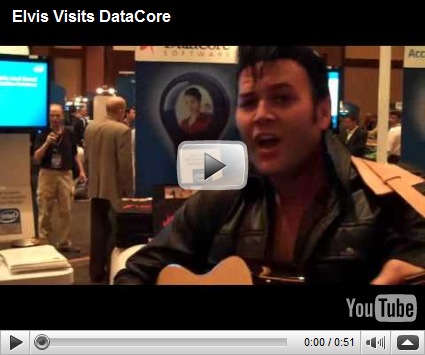
Elvis Visits DataCore At ISS 2009

Today was a great day at the Intel Solutions Summit 2009.  One of the highlights was Elvis stopping by for a rendition of Blue Suede Shoes.

LiveJournal Tags: ,

Technorati Tags: ,

del.icio.us Tags: ,

Saturday, March 14, 2009

Truth in Marketing: Active-Active vs. Active-Passive

Nothing sends me around the bend faster than when a vendor lies to me.  Now I realize that “lie” is a strong word and I shouldn’t use it in accusatory speech or in the written word.  I also understand that in areas of fast paced technological development there can be genuine cases of misunderstanding.  However none of the aforementioned circumstances apply to vendors who knowingly and blatantly misrepresent their products and features.  I think somewhere about the time I attended Kindergarten I learned this type of behavior was not only wrong but completely socially unacceptable. 

So why then do companies like EMC, HP, IBM and others market their Active-Passive (A/P) arrays as Active-Active (A/A)?  I actually have no idea but I will say that although I have the utmost respect for many of the folks in their engineering, R & D, and field teams I think the folks in their Marketing organizations are nothing but a pack of liars out to take advantage of the unaware.

Once upon a time I had occasion to be at Tech show and was casually talking with some of the staff at vendor (name withheld to protect the innocent) booth.  During the conversation the booth staffer began to elaborate on how their latest generation storage array had all these new cool features, enhancements and amongst other things was A/A.  Really?  Now I admit I’m not an expert in practically anything but I do know a little something about storage and what constitutes A/A verses A/P.  So I ask the intrepid marketeer how it was that this Nth generation, that came from a long line of arrays in this array family, was suddenly A/A given all previous generations were A/P. 

Oh, no he tells me, they’ve always been A/A, I must have been misinformed all these years.  Ok, it happens to the best of us, please tell me more.  Well, you see the A/A nature of our platform inherently gives it the ability to serve up LUNs from both Storage Processors (SP) at the same time.   Wow, that is simply amazing, possibly even revolutionary now that I think about it…are you kidding me? 

I was able to get control of myself just before I asked if he was mildly retarded or just storage stupid but not before I had to ask a couple of what I admit in retrospect were unfairly complex storage architecture questions.  I began by asking if their array was A/A then what is an A/P array do and how was theirs different and followed up with if all the paths to the LUNs were accessible simultaneously?  Well, no all the paths weren’t active because after all who would want that? 

That was it, I couldn’t take any more and explained that A/A actually mean that all paths through the SPs were active, all the time, hence the origin of the phrase “Active-Active controllers.”  I further explained that when you have an Nth generation system where only some of the paths are active due to the fact that you couldn’t access the LUN through the other controller unless you trespassed the LUN, it meant that it was in fact an A/P array.  He was absolutely incredulous and proceeded to call over an Engineer who would attempt to brain wash me, I mean educate me further in the Jedi ways of storage. 

The Engineer walks over eager to assist and says that I was in fact correct but that they choose to define A/A as meaning you can “actively use both controllers at the same time, just not with the same LUN, of course.”   Well that certainly clears things up, I mean after all, let’s not let little things like commonly accepted definitions and facts get in the way of good marketing.  In fact, I think its a great idea that vendors just make up whatever they want and tell prospective customers whatever they think they want to hear.

I’m officially done ranting about this issue (probably not) however I do want to point out that there are a number of storage vendors grossly misrepresenting their product’s features and capabilities.  If you are not well versed in the technology you are looking at, listen to what they have to say and ask someone you trust.  If all else fails, ask me.  It’s not that I’m any more likely than anyone else you may have asked to know the answer but at least you’ll know I won’t tell you your new Nth generation array is A/A if it is not.

                                    ###